




Reading Ruskin's Cultural Heritage: conservation and transformation

|
| Reading Ruskin's Cultural Heritage: conservation and transformation, Gill Chitty, Routledge, 2023, 176 pages, 16 black-and-white illustrations. |
What are we to make of John Ruskin? As early as 1849, he expressed what would later be known as the principles of sustainable development and environmentalism. The first intake of Labour MPs, asked in 1906 which author had most influenced them, all named Ruskin. His work is still relevant to thinking about cultural heritage and building conservation.
But Ruskin admitted that he did not consider that he had reached a balanced position on any subject unless he had contradicted himself at least three times. His writing was variously eloquent, inspiring, overblown and opaque. He is accused of combining an understanding of the value of historic buildings and places with a narrow-minded fetishism for materials.
Gill Chitty’s book focuses on Ruskin’s writing on architecture and buildings, and landscape and cultural heritage. She presents six essays of her own, each followed by an extract from Ruskin’s writing on art, architecture or culture.
Her essay on ‘Restoration and conservation futures’, for example, explains Ruskin’s theories of perception and his aims for The Seven Lamps of Architecture. Chitty discusses how his ideas on preservation connected and, at times, conflicted with those of his contemporaries. She suggests how his own thinking was transformed in the hands of others and sets it in the context of current thinking on heritage futures.
The Ruskin extract that follows that essay is from The Opening of the Crystal Palace. Ruskin recalls that ‘in the year 1851, when all that glittering roof was built, in order to exhibit the paltry arts of our fashionable luxury, the carved bedsteads of Vienna, and glued toys of Switzerland, and gay jewellery of France – in that very year, I say, the greatest pictures of the Venetian masters were rotting at Venice in the rain, for want of a roof to cover them, with holes made by cannon shot through their canvas.’ He goes on to propose alternative priorities.
Chitty’s essay on ‘Ruskin on craft and labour’, showing how his ideas influenced the arts-and-crafts movement and the revival of traditional craft making, is followed by an extract in which Ruskin sets out three precepts for a well-made thing. Choose only necessary things made with inventiveness, he urged; expect a finish to have practical use or meaningful design intention; and make replicas only when needed as a record.
‘Is it that [Ruskin’s] words connect into something fundamental, the tactile experience of handling an object made with careful skill by another human, and the uncanny way it can connect over time?’ Chitty asks. ‘Or does he simply, but profoundly, expose the complex relationship between the work of the hand and the mind, between labour and ingenuity, between the way that a society produces things and its values?’
That thought prompts her to wonder how it would work to apply Ruskin’s three rules for ethical production to today’s conservation practice; and whether there is a line for future conservation thinking there, ‘to follow the path of craft practice into a different modernity.’
Chitty’s essays are superb and her extracts from Ruskin constitute an admirably short selection from the vast swathes of his work. There is a great deal of enlightenment to be found here and much thought will be provoked.
At £90 for 176 pages and only a few illustrations, the book is ridiculously expensive.
This article originally in the Institute of Historic Building Conservation’s (IHBC’s) Context 179, published in March 2024. It was written by Rob Cowan, editor of Context.
--Institute of Historic Building Conservation
Related articles on Designing Buildings Conservation.
IHBC NewsBlog
IHBC sponsors Gardens Trust event 23-4 Sept 2026
.jpeg)
'Learning from the Past, Shaping the Future’ takes place in Milton Keynes
Renovations to Frank Lloyd Wright's Fallingwater complete
.jpg)
World Heritage Preserved project opens house for tours again
Shakespeare Birthplace Trust places Hall's Croft on HAR Register
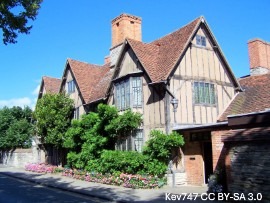
Stratford-upon-Avon home of Shakespeare's daughter is 'At Risk'
Lady Grange’s House repaired on St Kilda
.jpg)
National Trust for Scotland repairs stone cleit with link to famous island resident
Griff Rhys Jones on BBC Radio 4 Today programme
,_Green_Lane,_Derby.jpg)
The Victorian Society’s President unveiled its latest Top Ten Endangered Buildings 2026.
Need a MATE? Book your place now.
IHBC offers free webinars on applying for IHBC accreditation (Full & Associate).
UK Stained Glass Repository finds windows new homes
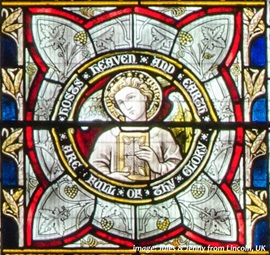
How are stained glass windows are rescued, stored and repurposed?
APPGEBE report sets high aims for quality
'Government must not sacrifice quality in drive to build 1.5m homes'
New measures protect Historic Shipwrecks from heritage crime

Underwater cultural heritage benefits from new HE guidance
How could the City of London skyline look in 6 years' time?

Visualisation shows approved planning applications as completed buildings
National Trust for Scotland calls for VAT cuts

Heritage neglect is encouraged by current policies
IHBC's 'Context' Issue 186 features Industrial Heritage
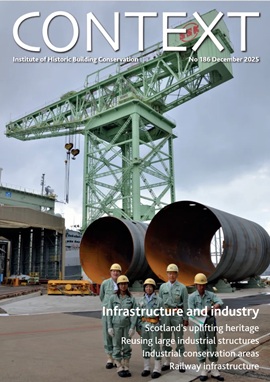
IHBC's members' journal reports on the challenges of conserving infrastructure
Book now for IHBC Annual School 2026
IHBC Annual School is taking place 18-20 June 2026 in Newcastle
RICHeS Research Infrastructure offers ‘Full Access Fund Call’
RICHeS offers a ‘Help’ webinar on 11 March
Latest IHBC Issue of Context features Roofing
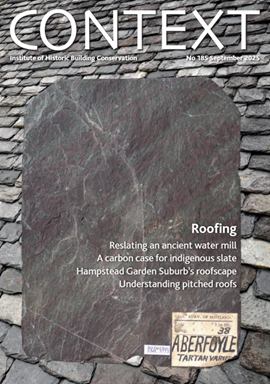
Articles range from slate to pitched roofs, and carbon impact to solar generation to roofscapes
Three reasons not to demolish Edinburgh’s Argyle House

Should 'Edinburgh's ugliest building' be saved?
IHBC’s 2025 Parliamentary Briefing...from Crafts in Crisis to Rubbish Retrofit
IHBC launches research-led ‘5 Commitments to Help Heritage Skills in Conservation’
How RDSAP 10.2 impacts EPC assessments in traditional buildings

Energy performance certificates (EPCs) tell us how energy efficient our buildings are, but the way these certificates are generated has changed.